Affiliate Disclosure: MyHomeGymPro.com is reader-supported. When you buy through links on our site, we may earn an affiliate commission at no extra cost to you. This helps us keep the lights on and continue creating honest, in-depth content for home gym owners.
Why a Rack with Weights Changes Everything
You spent weeks Frankenstein-ing your home gym together — a barbell from one brand, plates from another, a squat stand that wobbles every time you unrack anything over 225. Half your garage looks like a yard sale, and you’re still missing a cable station. Getting a proper rack with weights as a single package solves the mess. Instead of hunting down individual pieces and hoping they’re compatible, you get a matched system from day one. It’s the fastest way to go from “random equipment corner” to a gym that actually works.
Quick Answer
If you want the best rack with weights for a home gym, the Mikolo Power Cage with Cable Crossover System is our top pick. It handles up to 1,500 lbs, includes a LAT pulldown, cable crossover, and enough attachment points to cover nearly every compound and isolation lift — all in one frame. It’s built for serious lifters who don’t want to bolt together five different products.
TL;DR
The Mikolo Power Cage is a complete training station that replaces multiple machines. If you’re on a tighter budget or want a more portable package, the RitFit Multi-Function Garage & Home Gym Package is a strong runner-up with a solid all-in-one approach.
Key Takeaways
- A rack with weights eliminates compatibility headaches and saves money vs. buying everything separately.
- The Mikolo Power Cage supports 1,500 lbs and includes cable crossover, LAT pulldown, and J-hooks in one frame.
- Budget shoppers should look at the RitFit Multi-Function Package for a solid all-in-one starter setup.
- Ceiling height matters — check clearance for pull-ups and overhead presses before buying.
- A matched system holds resale value better than mismatched gear.
Table of Contents
What to Look For in a Rack with Weights
Weight Capacity
Look for at least 800 lbs if you’re intermediate, and 1,000+ for heavy squatting and deadlifting. The rating should cover the entire frame, not just the J-hooks.
Frame Gauge and Steel Quality
14-gauge steel is the minimum. 11-gauge or 12-gauge is commercial-quality. Wider 2×3-inch uprights accept more attachments and feel more stable than 2x2s.
Included Accessories
Some racks come bare. Others include J-hooks, safety bars, pull-up bar, LAT pulldown, cable crossover, and dip handles. The more included out of the box, the less you spend later.
Cable System Quality
Check pulley count and cable rating. Cheap single-pulley setups feel gritty. Smooth multi-pulley systems let you train back, triceps, biceps, and core without a separate machine.
Hole Spacing and Adjustability
Westside hole spacing (1-inch apart in the bench zone, 2-inch elsewhere) gives precise J-hook and safety placement. An inch of difference in unrack height can ruin your bench setup.
Footprint and Height
Most full-size cages sit 80–84 inches tall. Measure your ceiling before buying. You also need room behind the rack to load plates and step back for squats.
Weight Plate Compatibility
Confirm whether the system uses Olympic (2-inch) or standard (1-inch) plates. Olympic is the industry standard and gives you the best upgrade path long-term.
Common Mistakes When Buying a Rack with Weights
- Ignoring ceiling height. The fix: measure floor to ceiling and subtract at least 6 inches for clearance before ordering.
- Buying the cheapest option. Thin steel flexes under load and feels unsafe. The fix: prioritize frame quality over flashy attachments.
- Forgetting about plate storage. Plates on the floor are a hazard. The fix: choose a rack with built-in weight horns or budget for a plate tree.
- Skipping cable attachments. The fix: go with a rack that includes at least a basic LAT pulldown so you don’t need a separate machine.
- Not bolting the rack down. The fix: bolt to the floor or load the base pegs with extra plates for stability during heavy lifts.
Our Top Picks
Best Overall: Mikolo Power Cage with Cable Crossover System

The Mikolo Power Cage is built for lifters who want one piece of equipment to handle nearly everything. Rated at 1,500 lbs, this frame doesn’t flinch under heavy squats, bench presses, or rack pulls. It comes with a cable crossover system, LAT pulldown, low row, J-hooks, safety bars, and dip handles — straight out of the box.
Who it’s for: intermediate to advanced home gym owners who want a cable and free-weight station without bolting together five products. The dual cable pulleys are smooth enough for face pulls and cable flyes, and the crossover setup lets you hit angles that a basic rack can’t touch.
The honest trade-off? Assembly is a project — plan for 3–4 hours minimum with a partner. And at roughly 80+ inches tall, you’ll need adequate ceiling height. But once it’s up, you’ve essentially got a commercial gym corner in your garage.
CHECK PRICE ON AMAZON: https://amzn.to/3OHAXDS
Runner-Up: RitFit Multi-Function Garage & Home Gym Package
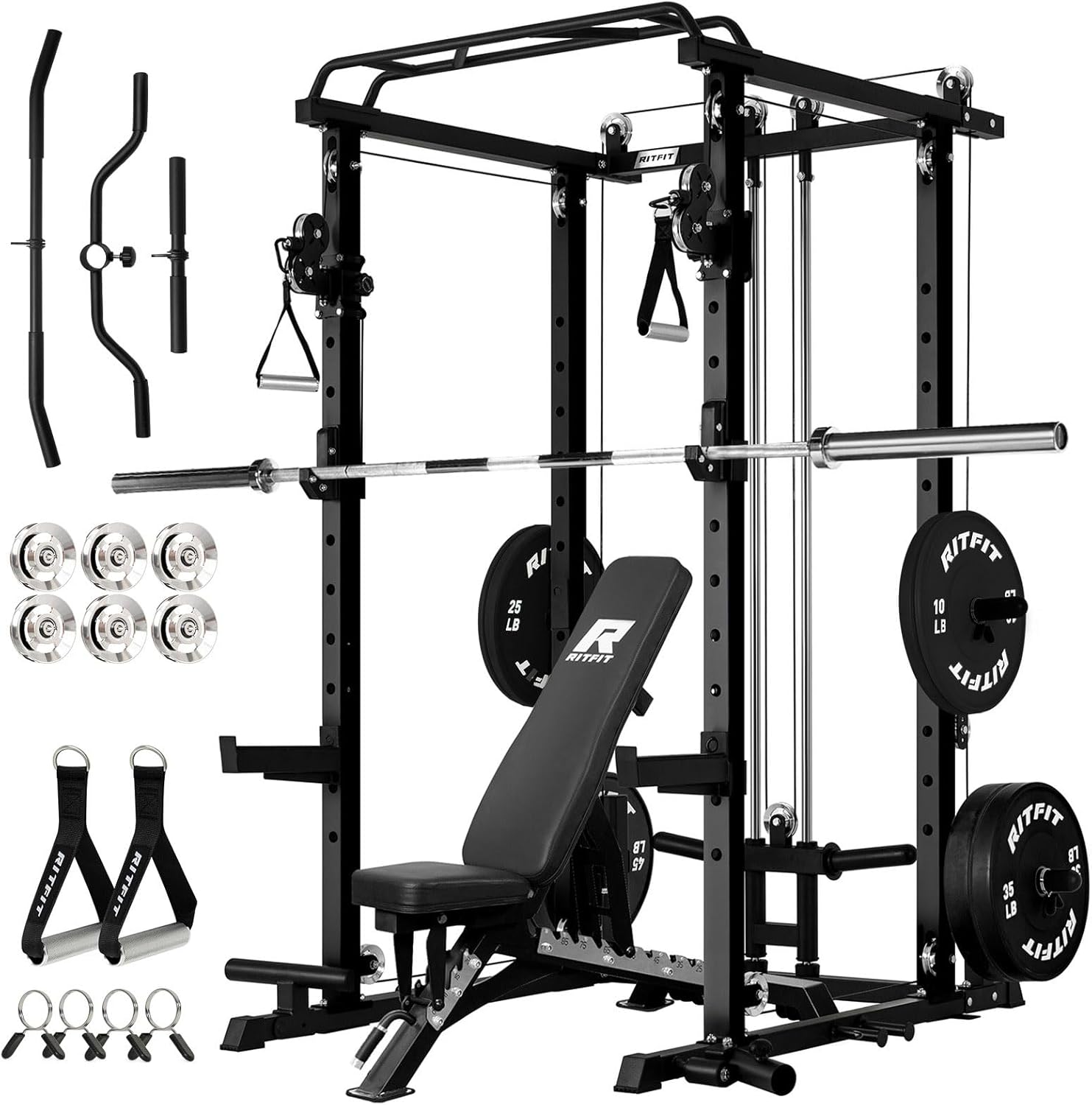
The RitFit Multi-Function Garage & Home Gym Package is a smart pick for anyone who wants a complete gym delivered in one shipment. Rather than piecing together a rack, barbell, plates, and accessories separately, RitFit bundles it all into a matched package designed to work together.
Who it’s for: beginners and intermediate lifters building their first serious home gym. It’s also great for garage gym owners who want a clean setup without spending weeks sourcing parts. The package approach means everything fits, everything matches, and you can start training the day it’s assembled.
The trade-off: it won’t match the raw capacity and cable versatility of a dedicated heavy-duty cage like the Mikolo. If you’re squatting 400+ or need advanced cable stations, you’ll outgrow this setup. But for the majority of home gym owners who train with moderate to heavy loads, it delivers excellent value.
CHECK PRICE ON AMAZON: https://amzn.to/4qSUluU
How to Get the Most Out of Your Rack with Weights
- Level the rack before loading. Use a torpedo level on the uprights. Even a slight lean gets worse under heavy weight.
- Grease the cable pulleys quarterly. Silicone lubricant keeps the system smooth. Skip it, and friction creeps in fast.
- Use the safeties every single set. It takes five seconds. Set them at the right height even on warm-ups.
- Organize plates on the storage pegs. Largest closest to the frame, smallest outside. Keeps weight centered and the rack stable.
- Add band pegs if your rack supports them. Bands are one of the cheapest ways to add accommodating resistance for squats and bench.
- Rotate your cable attachments. Rope handles, V-bars, and D-handles unlock dozens of isolation movements from one station.
Space and Setup Considerations
A full-size power cage needs about 5 x 5 feet for the frame alone. Add plate loading room and space to step back for squats, and you should plan for at least 8 x 8 feet of dedicated floor space.
Ceiling height is the silent deal-breaker. Most cages stand 80–84 inches tall. For pull-ups and overhead pressing, aim for at least 90 inches of clearance.
Flooring matters. 3/4-inch rubber horse stall mats protect your floor, dampen noise, and keep the rack from sliding. Check out our guide to home gym flooring mats for more options.
Don’t forget ventilation — a power cage in a closed garage turns into a sauna in summer. A box fan makes a huge difference.
Troubleshooting
- Rack wobbles during use → Tighten all bolts fully. If still wobbly, bolt the base to the floor or load the bottom pegs with plates.
- Cable feels sticky → Apply silicone spray to pulleys. If fraying is visible, contact the manufacturer for a replacement cable.
- J-hooks scratch the uprights → Wrap contact points with UHMW tape — cheap, self-adhesive, and protects powder coat.
- Pull-up bar feels too thick → Wrap with athletic tape or buy rubber pull-up grips.
- Safety bars don’t sit level → Confirm both sides are in the same numbered holes. Count from the bottom on each side.
Expert Take
According to the American Council on Exercise (ACE), compound barbell movements like squats, bench presses, and overhead presses rank among the most effective exercises for building strength and improving bone density. A power rack makes these lifts safer for home gym users with built-in safety catches.
The National Strength and Conditioning Association (NSCA) emphasizes progressive overload as the foundation of resistance training. A rack with weights — especially one with cables — gives you the tools to overload both compound and isolation movements without buying additional machines. For home gym owners, that versatility makes a power cage the single most important equipment investment.
FAQs
Is a power rack worth it for a home gym?
Absolutely. A power rack lets you squat, bench, and overhead press safely without a spotter. Add a cable system, and you can train nearly every muscle group from one station.
How much weight can a home power rack hold?
Most quality home racks hold 800–1,500 lbs. The Mikolo Power Cage, for example, is rated at 1,500 lbs. Always check the manufacturer’s rating before loading heavy.
Do I need to bolt my rack to the floor?
It’s not always required, but it’s strongly recommended for heavy lifting. Bolting prevents shifting during rack pulls, banded squats, and kipping pull-ups.
What ceiling height do I need for a power rack?
Most full-size cages are 80–84 inches tall. For comfortable pull-ups and overhead pressing, aim for at least 90 inches of ceiling clearance.
Can I do pull-ups on a power rack?
Yes. Nearly every power rack includes a pull-up bar. Some offer multiple grip options — wide, narrow, and neutral — for variety.
What’s the difference between a power rack and a squat stand?
A power rack is a full cage with four uprights and built-in safeties. A squat stand uses two uprights and is more compact but offers less safety for solo lifters.
Should I buy a rack with weights included or separately?
Buying a package saves time and ensures compatibility. However, buying separately lets you choose higher-quality plates and bars. It depends on your budget and preferences.
How long does it take to assemble a power rack?
Plan for 2–4 hours with a partner. Some heavier commercial-style cages can take longer. Good instructions and a socket wrench set make a big difference.
What flooring do I need under a power rack?
Rubber stall mats (3/4-inch thick) are the gold standard. They protect your floor, reduce noise, and keep the rack from sliding. Check out our guide to home gym flooring mats for more options.
Can I add attachments to my rack later?
Most racks with standard hole spacing accept third-party attachments like dip handles, landmine posts, and band pegs. Check your upright size and hole spacing before buying extras.
Conclusion
Building a legit home gym doesn’t have to mean spending months hunting down individual pieces and hoping they all work together. A rack with weights gives you a single, matched system that covers squats, bench, overhead work, cables, and more — all from one footprint. The Mikolo Power Cage is our top pick for its 1,500-lb capacity, built-in cable crossover, and rock-solid construction. If you want a more complete starter package at a friendlier price point, the RitFit Multi-Function Garage & Home Gym Package gets the job done with less hassle. Either way, you’re investing in equipment that’ll last for years and keep your training on track. Pick the one that fits your space, your goals, and your budget — and go lift something heavy.