The Step Count Struggle Is Real
You just crushed a heavy squat session in your garage gym. Legs are toast. But your step tracker is staring back at you with a pathetic 2,100 steps for the day. You know you need more daily movement — your lower back feels it, your recovery suffers without it, and you’re not about to drive to a commercial gym just to hop on a treadmill. That’s exactly where a walking pad treadmill fits into a home gym setup. It’s the simplest way to stack low-impact cardio on top of your training without eating up half your workout space.
Quick Answer
The best walking pad treadmill for most home gym owners is the WalkingPad R2 2-in-1 Folding. It folds in half, handles both walking and light jogging speeds, and slides under a desk or against a wall when you’re done. If you want a dedicated under-desk option at a lower price, the Sperax Under Desk Treadmill is a strong runner-up with a wider belt and quiet motor.
TL;DR
The WalkingPad R2 is our top pick for its 2-in-1 folding design, solid build, and versatility. The Sperax is a great budget-friendly alternative if you only plan to walk. Both fit easily in tight home gym spaces.
Key Takeaways
- Walking pads let you add 5,000–10,000+ daily steps without leaving your home gym
- The WalkingPad R2 handles walking and jogging (up to 7.5 mph) in a foldable frame
- The Sperax is a quieter, budget-friendly pick for walking-only use
- Belt width and motor power matter more than flashy screens or app integrations
- Most walking pads store vertically or under furniture, making them ideal for small spaces
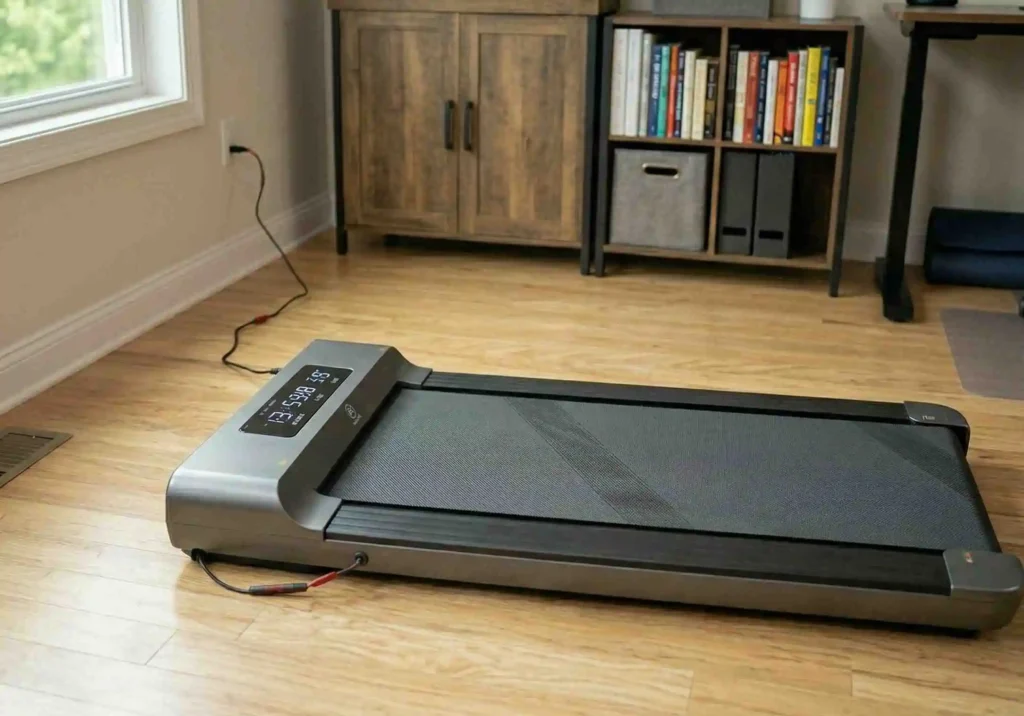
Table of Contents
What to Look For in a Walking Pad Treadmill
Belt Size and Walking Surface
This is where cheap walking pads fall apart. A belt that’s too narrow (under 16 inches) makes your stride feel cramped and unnatural. Look for at least 17 inches of width and 40 inches of length. If you’re taller than 5’10”, go longer.
Motor Power
Most walking pads run between 2.0 HP and 2.5 HP. That’s plenty for walking speeds of 1–4 mph. If you plan to jog occasionally, aim for at least 2.25 HP so the motor doesn’t strain and overheat during longer sessions.
Speed Range
Pure walking pads top out around 4 mph. Hybrid models (walk + jog) go up to 7–8 mph. Think about how you’ll actually use it. If it’s strictly a step-counting machine for between sets or while watching film, 4 mph is fine.
Noise Level
You’re probably using this in a shared living space or while on calls. Anything under 50 dB is considered quiet. Brushless DC motors tend to be the quietest option. Read user reviews specifically for noise complaints.
Foldability and Storage
The whole point of a walking pad is that it doesn’t hog space. Some fold in half, some slide under a couch, and some tilt upright against a wall. Measure your storage spot before you buy.
Weight Capacity
Most budget walking pads cap at 220 lbs. If you’re a bigger lifter, you need something rated for at least 265–300 lbs. Exceeding the limit kills the motor and voids your warranty.
Controls and Safety Features
A remote control is more practical than a touchscreen for under-desk use. An auto-stop function when you step off is a must-have safety feature, especially in homes with kids or pets.
Common Mistakes When Buying a Walking Pad Treadmill
- Ignoring the weight limit. Many lifters weigh 200+ lbs and grab the cheapest pad on Amazon. The fix: check the max user weight before anything else.
- Choosing based on top speed alone. A pad that hits 8 mph but wobbles at 3 mph is useless. The fix: prioritize stability and belt quality over speed specs.
- Forgetting about belt width. A narrow belt forces an awkward stride. The fix: measure 17″+ minimum; try 18″+ if you have a wider stance.
- Skipping noise reviews. Spec sheets rarely tell the real noise story. The fix: filter Amazon reviews for “noise” or “loud” before buying.
- Not measuring storage space. “Foldable” doesn’t mean it fits everywhere. The fix: measure your intended storage spot and compare it to the folded dimensions.
- Expecting a running treadmill. Walking pads are not built for sprints or incline work. The fix: if you need serious running, invest in a full-size treadmill instead.
Our Top Picks
Best Overall: WalkingPad R2 2-in-1 Folding

The WalkingPad R2 2-in-1 Folding is our top pick because it bridges the gap between a compact walking pad and a light jog treadmill. It folds completely in half, which is rare at this price point, and stores upright in a closet corner without hassle. The dual-mode design lets you walk hands-free up to about 3.7 mph or flip up the handlebar and push it to 7.5 mph for a light jog.
Build quality feels a step above most budget walking pads — the frame is aluminum alloy, the belt tracks smoothly, and the foot-sensing speed control works surprisingly well. It’s ideal for lifters who want to stack low-impact cardio on rest days or hit step goals between sets without disrupting their training flow.
Limitations: the belt is slightly narrower than some competitors, and the handlebar, while functional, feels a bit lightweight at higher speeds. Also, the companion app is basic and not a reason to choose this model.
CHECK PRICE ON AMAZON: https://amzn.to/4aMvmUa
Best Budget Pick: Sperax Under Desk Treadmill

The Sperax Under Desk Treadmill is a dedicated walking pad built for one thing: quiet, low-speed walking while you work or recover. It’s wider than the WalkingPad R2, which gives you more room to walk naturally, and the motor runs noticeably quieter — a real win if you’re using it during calls or in a shared room.
This one doesn’t fold in half, but its low profile (under 5 inches tall) means it slides under most couches and beds with ease. The LED display is embedded in the frame, keeping the look clean and minimal. Speed tops out around 4 mph, which is perfect for steady walking but rules out any jogging.
Limitations: it’s walking-only — no handlebar, no jog mode. The remote control feels cheap, and the weight capacity is on the lower side compared to the R2. But for pure step-counting duty, it’s hard to beat at this price.
CHECK PRICE ON AMAZON: https://amzn.to/4aMeNI3
How to Get the Most Out of Your Walking Pad
- Start slow and build. Begin with 15–20 minute sessions at 2 mph. Let your body adjust before cranking speed or duration.
- Use it between training sets. Walk at a gentle pace during rest periods to keep blood flowing without fatiguing your legs.
- Pair it with standing desk work. Stack your step count while answering emails. This is where walking pads earn their keep.
- Track your steps independently. Don’t rely on the pad’s built-in tracker. A wrist-worn tracker or phone pedometer is more accurate.
- Wear proper shoes. Socks or bare feet on a moving belt is a slip risk. Lightweight trainers with flat soles work best.
- Lubricate the belt monthly. Most pads come with silicone lubricant. A quick spray every 30 days keeps the belt smooth and extends motor life.
- Unplug when not in use. Walking pad motors draw a small standby current. Unplugging protects the electronics and saves energy.
Space and Setup Considerations
A walking pad treadmill is one of the most space-friendly pieces of cardio equipment you can own. Most models need a footprint of roughly 55″ × 20″ while in use — about the size of a yoga mat.
For storage, foldable models like the WalkingPad R2 cut that footprint in half and stand upright in a closet or behind a door. Low-profile pads like the Sperax slide under furniture when not in use.
Ceiling height is almost never an issue since you’re walking, not running on an elevated deck. Standard 8-foot ceilings are fine.
Place the pad on a hard, flat surface. Carpet can cause the base to shift and overheat the motor. If your gym floor is rubber matting, that works great — it also dampens any remaining vibration.
Ventilation isn’t a big concern for walking speeds, but keep the motor area clear of dust and debris. A quick vacuum around the base once a week prevents buildup.
Troubleshooting
- Belt drifts to one side → Adjust the rear roller bolts (usually a small Allen key) in quarter-turn increments until the belt centers.
- Motor shuts off mid-walk → Check for overheating. Let it cool for 20 minutes and make sure the belt is properly lubricated.
- Speed feels inconsistent → Recalibrate the foot-sensing speed control through the app or manual reset (check your owner’s manual).
- Remote isn’t responding → Replace the battery (CR2032 in most models) and make sure you’re within 6 feet of the pad.
- Squeaking noise from the belt → Apply silicone treadmill lubricant under the belt. Avoid WD-40 or household oils.
- Error code on the display → Unplug the unit for 60 seconds, then restart. If the code persists, contact the manufacturer before using it again.
Expert Take
Walking pad treadmills aren’t a gimmick — they’re backed by solid exercise science. According to the American Council on Exercise (ACE), low-intensity steady-state walking improves cardiovascular health, aids recovery between resistance training sessions, and contributes to overall daily energy expenditure without placing significant stress on joints or the central nervous system.
The National Strength and Conditioning Association (NSCA) has also emphasized the importance of non-exercise activity thermogenesis (NEAT) for body composition. A walking pad makes NEAT effortless by letting you accumulate steps during activities you’d do anyway — working, watching TV, or cooling down after a lift. For home gym owners who already prioritize strength training, a walking pad fills the cardio gap without the time commitment or joint stress of running.
FAQs
Is a walking pad treadmill worth it for a home gym?
Yes. It adds low-impact cardio and daily steps without taking up much space. It’s especially useful on rest days or between heavy lifting sessions.
How many calories does a walking pad burn?
Most people burn 200–400 calories per hour at moderate walking speed (3–4 mph), depending on body weight and pace.
Can you jog on a walking pad?
Only on hybrid models with a handlebar and higher speed range. Pure walking pads top out at 3–4 mph and lack the stability for jogging.
How loud is a walking pad treadmill?
Most quality models run under 50 dB, which is about the volume of a quiet conversation. Brushless motors are the quietest.
Do walking pads damage hardwood floors?
Not typically, but placing a rubber mat underneath protects your floor and keeps the pad from sliding. Avoid using directly on carpet.
How long do walking pad treadmills last?
With proper maintenance (belt lubrication, unplugging after use), a good walking pad should last 3–5 years of daily use.
What’s the weight limit on most walking pads?
Budget models usually cap at 220 lbs. Higher-end models handle 265–300 lbs. Always check the spec sheet if you’re a heavier user.
Can I use a walking pad while standing at my desk?
Absolutely — that’s one of the most popular uses. Keep your speed at 1.5–2.5 mph for comfortable typing and minimize the incline.
Are walking pad treadmills safe?
Yes, as long as you use them on a flat surface, wear proper footwear, and choose a model with an auto-stop safety feature.
Do I need to lubricate my walking pad?
Yes. Apply silicone-based treadmill lubricant under the belt every 30 days or every 40 hours of use, whichever comes first.
Conclusion
A walking pad treadmill is one of the smartest additions you can make to a home gym — especially if your training already revolves around heavy lifting and you just need a low-impact way to stay active between sessions. It doesn’t need to be fancy. It just needs a decent belt, a quiet motor, and the ability to disappear into a corner when you’re done.
The WalkingPad R2 2-in-1 Folding is our top recommendation because it handles both walking and light jogging in a compact, foldable package. If you only need a quiet walking companion for desk work or recovery days, the Sperax Under Desk Treadmill gets the job done at a friendlier price. Either way, your step count — and your recovery — will thank you. Pick one, plug it in, and start walking.