Affiliate Disclosure: MyHomeGymPro.com is reader-supported. When you buy through links on our site, we may earn an affiliate commission at no extra cost to you. This helps us keep creating honest, in-depth home gym content.
You spent months dialing in your squat rack, your bench, and your plate collection. Your strength training is locked down. But here’s the gap most home gym owners ignore — low-impact cardio that actually torches calories without eating up half your garage. A treadmill is huge. A bike gets boring fast. Meanwhile, you’re skipping cardio entirely because nothing fits your space or your budget. That’s exactly where a solid stair stepper machine for home use earns its spot.
Quick Answer
If you’re short on time, here’s the bottom line: the GMWD Stair Stepper Machine is our pick for the best stair stepper machine for home in 2026. It delivers smooth, quiet stepping action in a compact footprint, with adjustable resistance and a solid build that handles daily use. It’s ideal for home gym owners who want effective lower-body cardio without dedicating an entire room to it.
TL;DR: A home stair stepper gives you intense cardio and glute work in under two square feet of floor space. The GMWD Stair Stepper is our top choice for its stability, smooth hydraulics, and excellent value. If you want a feature-rich alternative with digital tracking, the MERACH Stair Stepper is a strong second pick.
Key Takeaways
- Stair steppers deliver one of the highest calorie burns per minute of any low-impact cardio machine.
- You don’t need a big space — most mini steppers fit in a closet when not in use.
- Hydraulic cylinder quality matters more than any digital feature.
- A solid stair stepper should last 3–5 years with minimal maintenance.
- Look for models with a weight capacity that exceeds your body weight by at least 30 lbs for stability.
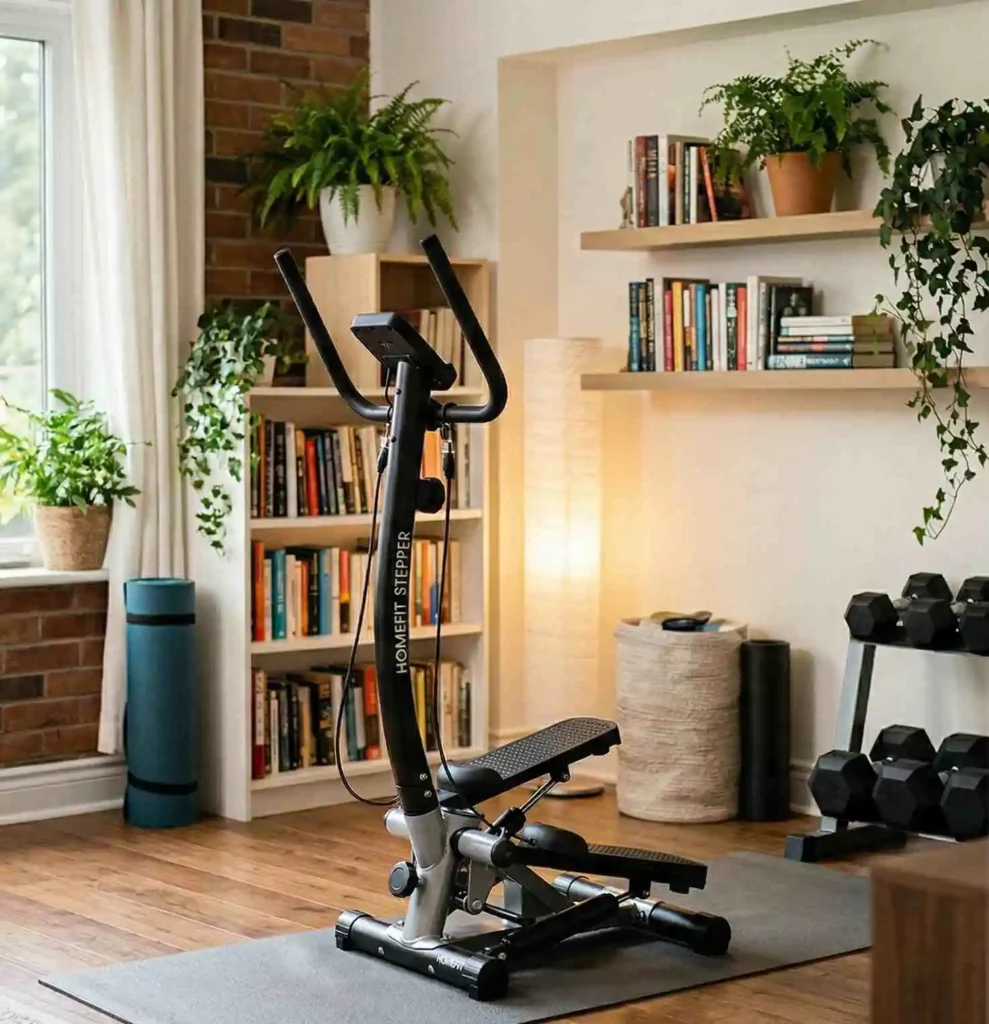
Table of Contents
What to Look For in a Stair Stepper Machine for Home
Step Resistance and Adjustability
The resistance mechanism is the heart of any stepper. Hydraulic cylinders control the feel and intensity of each step. Look for models with adjustable resistance so you can scale from easy warm-ups to brutal HIIT finishers. Cheap steppers often use single-piston systems that feel jerky and uneven. Dual-cylinder setups are much smoother and more durable.
Weight Capacity and Frame Stability
A wobbly stepper is a dangerous stepper. Check the maximum weight capacity and look for a wide, steel base. Even if you weigh 180 lbs, choose a model rated for 250+ lbs. That extra engineering margin means the machine stays planted during aggressive stepping.
Footplate Size and Texture
Your feet need to stay locked in place, especially when you’re sweating hard. Oversized, textured footplates reduce slipping and give your ankles a more natural range of motion. Small, narrow plates force an awkward gait that stresses your knees over time.
Noise Level
If you train early morning or late at night, noise is a dealbreaker. Hydraulic steppers are generally quieter than chain-driven or air-resistance models. Still, quality varies wildly. Read real user feedback on noise before buying.
Digital Console and Tracking
A basic LCD showing steps, time, and estimated calories is nice to have. But don’t pay a premium for Bluetooth connectivity or app integration unless you’ll actually use it. The stepping motion matters far more than a fancy screen.
Portability and Storage
One of the biggest advantages of a home stair stepper is that it tucks away after a session. Look for lightweight models (under 25 lbs) with a carry handle. Bonus if it fits under a desk or in a closet.
Build Quality and Warranty
Steel frames beat plastic housings every time. A decent warranty (at least 1 year on the frame, 90 days on hydraulics) shows the manufacturer stands behind the product. If a stepper has no warranty information listed, treat that as a red flag.
Common Mistakes When Buying a Stair Stepper
- Buying the cheapest model on Amazon. Ultra-budget steppers use flimsy hydraulics that fail within months. The fix: spend slightly more on a reputable brand with solid reviews.
- Ignoring weight capacity. A stepper rated at 200 lbs will flex and wobble for a 190-lb user. The fix: always choose a machine rated at least 30 lbs above your weight.
- Focusing on digital features over build. A Bluetooth-connected stepper with weak hydraulics is a waste of money. The fix: prioritize the resistance mechanism and frame before any extras.
- Skipping the resistance check. Some steppers have fixed resistance that’s either too easy or too hard. The fix: pick a model with adjustable resistance levels.
- Not measuring your ceiling height. Stepping adds 6–10 inches to your standing height. The fix: make sure you have at least 12 inches of clearance above your head.
- Forgetting about maintenance. Hydraulic cylinders need occasional lubrication. The fix: check the manual for maintenance intervals and keep silicone lubricant on hand.
Our Top Picks for the Best Stair Stepper Machine for Home
Best Overall: GMWD Stair Stepper Machine

The GMWD Stair Stepper Machine earned the top spot because it nails the fundamentals without overcomplicating things. It’s built on a wide steel base that stays rock-solid during fast-paced stepping. The dual hydraulic cylinders provide smooth, consistent resistance, and you can adjust the intensity to match your workout — from steady-state cardio to all-out intervals.
The oversized non-slip footplates keep your stance comfortable and secure. It handles users up to 330 lbs, which gives most people a generous stability margin. The included LCD tracks steps, time, and calories. At around 20 lbs, it’s easy to move and store in a corner or closet. The only real knock is that the console is basic — no app syncing or preset programs. But honestly, for a stepper, that’s a feature, not a bug.
Best for: Home gym owners who want a reliable, space-efficient cardio tool that just works.
CHECK PRICE ON AMAZON: https://amzn.to/4tX9CxR
Best Runner-Up: MERACH Stair Stepper for Home Gym

The MERACH Stair Stepper for Home Gym is a strong alternative if you value workout tracking and a slightly different step feel. MERACH has built a reputation for clean, modern home fitness gear, and this stepper reflects that. The stepping motion is smooth thanks to quality hydraulic cylinders, and the resistance adjusts easily.
Where the MERACH stands out is its digital integration. The console offers more detailed readouts and the overall design feels more polished. It’s compact and portable, fitting easily beside a power rack or under a desk. The weight capacity is solid for most users. One limitation is that it tends to run a touch pricier than stripped-down competitors. Still, if data tracking motivates you, the MERACH delivers.
Best for: Users who want a polished stepper with better-than-average tracking features.
CHECK PRICE ON AMAZON: https://amzn.to/40q03K2
How to Get the Most Out of Your Stair Stepper
- Start with 10-minute sessions. Stair stepping is deceptively intense. Your calves and glutes will remind you the next day. Build up to 20–30 minutes over a few weeks.
- Keep your posture upright. Don’t lean on the handlebars or hunch forward. Stand tall, engage your core, and let your legs do the work. This maximizes glute activation and protects your lower back.
- Use interval training. Alternate 30 seconds of fast stepping with 60 seconds of slow recovery. According to the American Council on Exercise, interval training on a stepper can burn significantly more calories than steady-state stepping.
- Don’t death-grip the handles. Light fingertip contact for balance is fine. Holding on tight shifts the load off your legs and reduces the effectiveness of the workout.
- Add resistance bands. Hook a band around the frame and do bicep curls or lateral raises while stepping for a total-body session.
- Track your steps weekly. Consistency beats intensity. Aim for a weekly step goal rather than one brutal session that leaves you sore for days.
- Maintain your machine. Wipe down the footplates after each session and apply silicone lubricant to the cylinders every 3–6 months.
Space and Setup Considerations
A home stair stepper is one of the most space-friendly cardio machines you can own. Most mini steppers occupy about 16 x 12 inches of floor space — smaller than a doormat. You can set one up in a bedroom corner, beside your squat rack, or even under a standing desk for light stepping during work.
Ceiling height matters more than floor space. When stepping, you rise 6–10 inches above your normal standing height. Make sure you have at least 12 inches of overhead clearance to avoid bumping your head, especially in basement gyms with low ceilings.
No special flooring is needed, but a rubber mat underneath helps prevent the stepper from sliding on hardwood or tile. It also dampens any vibrations. Ventilation isn’t critical since steppers don’t generate the kind of heat a treadmill sprint does, but a small fan nearby helps during longer sessions.
Troubleshooting Common Stair Stepper Issues
- Squeaking or grinding noise → Apply silicone-based lubricant to the hydraulic cylinder shafts. Avoid WD-40 — it dries out and attracts dust.
- Uneven stepping height → Check that both hydraulic cylinders are set to the same resistance level. If one side is shorter, the cylinder may be wearing out.
- Stepper slides on floor → Place a rubber gym mat or anti-slip pad underneath. On carpet, the machine may feel more stable without a mat.
- LCD console not displaying → Replace the batteries (usually AAA or watch-style). If still blank, check the wire connection between the console and the frame.
- Footplates feel loose → Tighten the bolts underneath each plate with the included wrench. Check monthly, as vibrations loosen hardware over time.
- Resistance too easy at max setting → Your hydraulics may be losing pressure. Contact the manufacturer for replacement cylinders under warranty.
Expert Take
Stair stepping has long been recognized as one of the most efficient forms of cardiovascular exercise, especially for lower-body conditioning. Research highlighted by the National Strength and Conditioning Association (NSCA) shows that stair climbing activates the glutes, quadriceps, and calves simultaneously while demanding significant cardiovascular output — making it a time-efficient option for people who train at home and want to maximize every minute.
For home gym owners specifically, a compact stair stepper solves a real problem: getting meaningful cardio without sacrificing space you need for barbells and racks. The American College of Sports Medicine (ACSM) recommends 150 minutes of moderate-intensity aerobic activity per week. A stair stepper lets you hit that target in your own garage, rain or shine, no gym commute required. If you already strength train 3–4 days per week, adding 15–20 minutes of stepping on rest days or as a warm-up is a practical, evidence-backed approach to rounding out your fitness.
FAQs
Is a stair stepper machine good for losing weight? Yes. Stair stepping burns a high number of calories relative to the time spent. Combined with a calorie deficit and strength training, it’s an effective fat-loss tool for home gym use.
How long should I use a stair stepper each day? Start with 10–15 minutes and build up to 20–30 minutes. For general health, aim for at least 150 minutes of moderate cardio per week across all activities.
Are stair steppers bad for your knees? Generally, no. Stair stepping is low-impact compared to running. However, if you have existing knee issues, start slowly and avoid locking out your knees at the top of each step.
Can I use a stair stepper every day? You can, but listen to your body. Most people benefit from 4–5 sessions per week with rest days mixed in. Daily light stepping at low intensity is fine for active recovery.
How many calories does a stair stepper burn? Roughly 200–400 calories per 30 minutes depending on your weight and intensity. Interval-style stepping pushes the number higher than steady-state.
Do mini stair steppers actually work? Yes. They engage your glutes, calves, and quads effectively. They won’t replace heavy squats, but they’re excellent for cardio and supplemental lower-body conditioning.
What muscles does a stair stepper work? Primarily the glutes, quadriceps, hamstrings, and calves. Your core also engages to maintain balance, especially if you avoid leaning on the handles.
Is a stair stepper better than a treadmill for home use? For small spaces, yes. A stepper takes up a fraction of a treadmill’s footprint and costs far less. Treadmills offer more workout variety, but steppers win on space efficiency and portability.
How do I maintain my stair stepper machine? Wipe down footplates after each use, tighten hardware monthly, and lubricate hydraulic cylinders every 3–6 months with silicone-based lubricant.
What’s a good weight capacity to look for in a home stair stepper? Choose a stepper rated at least 30 lbs above your body weight. For most users, a 250–330 lb capacity provides the stability and durability you need for daily use.
Conclusion
A stair stepper machine for home use is one of the smartest additions you can make to a home gym — especially if space and budget are tight. It delivers serious lower-body and cardio work in a footprint smaller than most gym bags. The key is choosing a model with quality hydraulics, a stable frame, and adjustable resistance so it grows with your fitness level.
Our top pick, the GMWD Stair Stepper Machine, checks every box. It’s stable, smooth, built to last, and stores away in seconds. If you want a bit more polish and digital tracking, the MERACH Stair Stepper is a worthy alternative. Either way, you’re adding a cardio tool that earns its place in your home gym without stealing space from your barbell setup.
Ready to step up your cardio game? Grab our top pick and start with just 10 minutes a day. Your legs — and your heart — will thank you.