Affiliate Disclosure: MyHomeGymPro.com earns a small commission from qualifying purchases made through the links in this article, at no extra cost to you. We only recommend products we genuinely believe in.
You’ve been deadlifting with a straight barbell for years, and your lower back is starting to remind you about it every morning. You love pulling heavy, but your home gym is tight and a closed hex bar makes farmer’s walks impossible without crashing into your rack. An open trap bar fixes that problem — and a few others you didn’t know you had. Finding the right one, though, means sorting through a pile of cheap knockoffs and overbuilt specialty bars that cost more than your power rack.
Quick Answer
An open trap bar is a hexagonal deadlift bar with open ends that let you walk through the frame for carries, lunges, and other movements a closed hex bar can’t handle. Our top pick is the Bells of Steel Open Trap Bar — it’s built like a tank, fits Olympic plates, and gives you the open-ended versatility serious lifters actually need. If you’re a home gym owner who wants one bar to handle deadlifts, shrugs, farmer’s walks, and even rows, an open trap bar is one of the smartest investments you’ll make.
TL;DR
The Bells of Steel Open Trap Bar is our best overall pick for its durability, smart design, and capacity to handle serious loads. On a tighter budget, the CAP Olympic Open Trap Bar gets the job done at a lower price point. Either way, an open trap bar belongs in every well-equipped home gym.
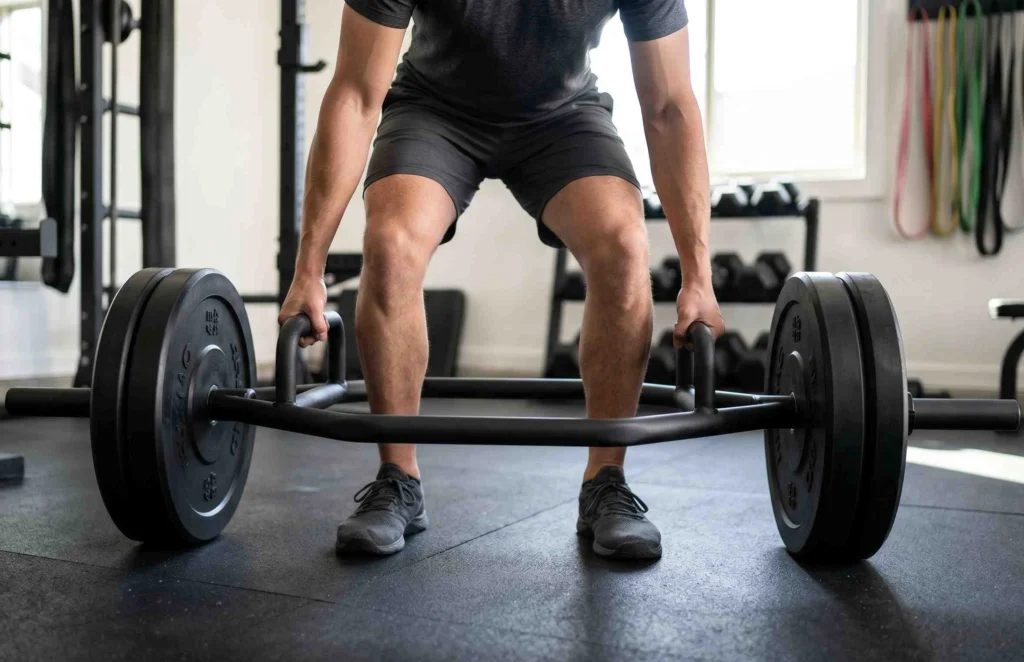
Table of Contents
Key Takeaways
- Open-ended design lets you do farmer’s walks, lunges, and step-throughs that a closed hex bar simply can’t.
- Reduced lower back stress compared to straight bar deadlifts — the neutral grip and centered load make a real difference.
- Bells of Steel is our #1 pick for build quality, weight capacity, and sleeve length.
- CAP is a solid budget option if you’re lifting under 400 lbs and want to save some cash.
- Check your ceiling height before buying — trap bar deadlifts with bumper plates need overhead clearance for lockout.
What to Look For in an Open Trap Bar
Frame Design and Open Ends
The whole point of an open trap bar is the open-ended frame. Look for a design where the opening is wide enough to walk through comfortably without banging the plates on your legs. Some cheap bars cut corners here with narrow openings that defeat the purpose.
Weight Capacity
You want a bar rated for at least 500 lbs if you’re serious about progressive overload. Bars with lower ratings tend to flex under heavy loads, and that flex feels sketchy when you’re pulling near your max. Check the manufacturer’s stated capacity and read user reviews for real-world feedback.
Sleeve Length
Longer sleeves mean more room for plates. This matters more than most people think, especially if you’re using bumper plates (which are thicker than iron). A bar with short sleeves limits how much weight you can load before running out of space.
Handle Height Options
Some open trap bars offer dual handles — a high and low position. The high handles reduce your range of motion, which is great for heavier pulls or lifters with mobility limitations. Low handles mimic a conventional deadlift depth. Having both options in one bar adds real training versatility.
Knurling and Grip
You’re going to be holding this bar under heavy load. Aggressive knurling helps, but too aggressive and it shreds your hands during high-rep sets. Look for medium knurling that balances grip security with comfort. Some bars also offer wider grip spacing to better mimic a natural arm position.
Overall Build Quality
Weld quality, finish coating, and sleeve rotation all matter for longevity. Powder-coated bars resist rust better than bare steel, which is important in a garage gym that sees humidity. Smooth-spinning sleeves protect your wrists during movements where the plates need to rotate freely.
Total Weight of the Bar
Trap bars themselves range from about 45 lbs to 70+ lbs. If you’re tracking your lifts precisely, you need to know the bar weight. Heavier bars tend to feel more stable, but they also mean you’re starting with more weight on day one.
Common Mistakes When Buying an Open Trap Bar
- Buying a closed hex bar by accident. Open and closed look similar in product photos. Double-check that the frame has open ends before ordering. The fix: Read the product title and description carefully — “open” or “open-ended” should be explicitly stated.
- Ignoring sleeve length. Short sleeves mean you max out on plate capacity faster than you’d expect. The fix: Look for sleeves at least 10 inches long, especially if you use bumper plates.
- Overlooking your ceiling height. Trap bar deadlifts at lockout put the bar higher than you think, especially with bumper plates. The fix: Measure from your floor to ceiling and subtract your height plus 6 inches. You need at least that much clearance.
- Choosing based on price alone. The cheapest open trap bars often have poor welds, short sleeves, and low weight limits. The fix: Treat this as a long-term investment. Spend a little more upfront and you won’t need to replace it.
- Forgetting about storage. Open trap bars are bulky. They don’t hang on a standard barbell holder easily. The fix: Plan a dedicated storage spot — leaning it in a corner or storing it flat under your rack works for most setups.
- Not checking plate compatibility. Some bars use non-standard sleeve diameters. The fix: Confirm the sleeves are standard Olympic size (2-inch diameter) so your existing plates fit.
Our Top Picks
Best Overall: Bells of Steel Open Trap Bar

The Bells of Steel Open Trap Bar is the bar we’d put in our own garage gym without thinking twice. It handles serious weight with zero flex, the open-ended design is genuinely wide enough for farmer’s walks without plate interference, and the knurling hits that sweet spot between grippy and comfortable. The dual-height handles give you training options most budget bars don’t offer. If there’s a downside, it’s the price — this isn’t the cheapest option out there. It’s also heavier than some competitors, which could be a factor if you’re a lighter lifter just starting out. But for anyone pulling 300+ lbs and wanting a bar that’ll last a decade, this is the one.
CHECK PRICE ON AMAZON: https://amzn.to/46pGDbN
Best Budget Pick: CAP Olympic Open Trap Bar

The CAP Olympic Open Trap Bar is a no-frills option that gets the fundamentals right at a price that won’t hurt your wallet. It fits standard Olympic plates, the open-ended frame works for carries and walk-throughs, and it’s sturdy enough for most recreational lifters. Where it falls short is in weight capacity and overall refinement — the knurling is less aggressive, the sleeves are shorter, and you’ll feel some flex if you start loading 400+ lbs. For home gym owners who deadlift moderate weight and want an affordable entry into open trap bar training, CAP delivers solid value.
CHECK PRICE ON AMAZON: https://amzn.to/4r9hLwA
How to Get the Most Out of Your Open Trap Bar
- Start with the high handles. If you’re new to trap bar deadlifts, the elevated grip reduces range of motion and lets you focus on form before going deep.
- Use it for farmer’s walks weekly. This is the open trap bar’s superpower. Load it up, walk 40–60 feet, rest, repeat. Your grip strength and core stability will skyrocket.
- Program it as your main deadlift variation. Swap your straight bar deadlift for trap bar pulls for 4–6 week blocks. Your quads and traps will thank you, and your lower back gets a break.
- Don’t neglect shrugs. The neutral grip position on a trap bar makes heavy shrugs feel way more natural than a straight barbell. Keep reps controlled — no bouncing.
- Try split squats and lunges. The open ends let you step through the frame for single-leg work. It’s awkward at first, but once you nail the balance, it’s a game-changer for leg development.
- Keep the sleeves clean. Wipe down the loading sleeves after every session, especially in a humid garage. A light coat of 3-in-1 oil every month prevents rust and keeps plates sliding on smoothly.
- Track your bar weight separately. Trap bars weigh more than a standard 45-lb barbell. Know your bar’s exact weight so your training log stays accurate.
Space and Setup Considerations
An open trap bar needs more floor space than a straight barbell because of the frame width. Plan for a footprint of roughly 4 feet wide by 7 feet long when loaded with plates. You need to stand inside the frame, so make sure there’s nothing obstructing the area at hip level.
Ceiling height matters more than people expect. At lockout, the top of your head plus the height of the bar and plates needs to clear the ceiling. If you’re 6 feet tall and training in a basement with 7-foot ceilings, measure before you buy. Bumper plates add extra height compared to iron plates.
Flooring should be solid and flat. Horse stall mats over concrete are the gold standard for most home gyms. Avoid thick foam tiles — they compress under heavy loads and make the bar feel unstable. If you’re doing farmer’s walks, you’ll also want a clear path of at least 40 feet, which might mean walking into a hallway or driveway.
Storage is straightforward but takes planning. Most open trap bars can lean vertically in a corner or slide flat under a rack or bench. They won’t fit on standard barbell wall mounts, so don’t count on that.
Troubleshooting
- Bar wobbles during deadlifts → Check that your flooring is level. Uneven mats or a sloped garage floor cause instability. Shim the low side if needed.
- Plates slide during farmer’s walks → Use spring clips or proper Olympic collars. The cheap wire clips that come with most plate sets slip under heavy lateral movement.
- Hands slip on heavy pulls → Chalk up. Liquid chalk works great in home gyms because it doesn’t make a mess. If the knurling is too smooth, lifting straps are fine for working sets.
- Sleeves are rusty → Sand lightly with fine steel wool, wipe clean, and apply a thin coat of 3-in-1 oil. Going forward, wipe sleeves dry after every session.
- Bar doesn’t sit flat on the ground → Some trap bars have a slight manufacturing bow. Check on a known-flat surface. If it’s minor, it won’t affect performance. If it’s severe, contact the manufacturer for a replacement.
Expert Take
The trap bar deadlift has solid research backing it as a safer and equally effective alternative to the conventional barbell deadlift for most training goals. According to the American Council on Exercise (ACE), the trap bar deadlift produces similar muscle activation in the glutes and hamstrings while placing significantly less shear force on the lumbar spine. The National Strength and Conditioning Association (NSCA) has published research showing that trap bar deadlifts allow most lifters to move more weight compared to a straight bar, partly because the load is centered around the body rather than in front of it.
An open trap bar takes those benefits further by unlocking loaded carries — an exercise category that strength coaches at every level consider foundational for real-world functional strength. If you’re building a home gym and can only pick one specialty bar, an open trap bar gives you the most training versatility per dollar spent.
FAQs
What is an open trap bar?
An open trap bar is a hexagonal deadlift bar with open ends instead of a closed frame. The open design lets you walk through the bar for farmer’s walks, lunges, and other movements that require forward stepping.
Is an open trap bar better than a closed hex bar?
For most home gym owners, yes. The open ends add farmer’s walks and lunges to your exercise options without sacrificing any deadlift performance. A closed bar only wins if you need maximum rigidity at extreme loads.
How much does an open trap bar weigh?
Most open trap bars weigh between 45 and 65 lbs, depending on the brand and build. Always check the manufacturer’s specs and weigh it yourself if possible for accurate training logs.
Can I do squats with an open trap bar?
Yes. Trap bar squats are a real exercise — you stand inside the frame, grip the handles, and squat. The movement pattern is closer to a leg press angle than a back squat, making it easier on your shoulders and spine.
Do I need special plates for an open trap bar?
No. As long as your open trap bar has standard 2-inch Olympic sleeves, any Olympic plates — iron or bumper — will fit.
Is the trap bar deadlift easier than a conventional deadlift?
Most people can lift more weight with a trap bar because the handles are at your sides, not in front. It’s not “easier” — it just distributes the load differently, reducing lower back demand while increasing quad involvement.
How much space do I need for an open trap bar?
Plan for a minimum area of about 4 by 7 feet for deadlifts. If you want to do farmer’s walks, you’ll need a clear walking path of at least 40 feet.
Can beginners use an open trap bar?
Absolutely. The trap bar deadlift is actually one of the best pulling movements for beginners because the neutral grip and centered load make proper form more intuitive than a straight barbell.
Will an open trap bar fit on a standard barbell rack?
No. Open trap bars are too wide for standard J-hooks or barbell wall mounts. Plan to store yours leaning in a corner or lying flat under equipment.
How do I maintain my open trap bar?
Wipe down the sleeves and handles after each session. Apply a light coat of 3-in-1 oil to the sleeves monthly. Store it indoors or in a dry area to prevent rust, especially if you have a garage gym.
Conclusion
An open trap bar is one of those home gym additions that punches way above its weight class. It replaces your hex bar deadlift, adds loaded carries and single-leg work, and takes real stress off your lower back — all in one piece of equipment. The Bells of Steel Open Trap Bar is our top recommendation for lifters who want something built to last and capable of handling heavy loads for years. If budget is the priority, the CAP Olympic Open Trap Bar is a solid starting point that covers the basics without breaking the bank. Either way, once you start pulling from inside an open trap bar, you’ll wonder why you waited so long. Pick one, load it up, and get to work.